- Published on
What Is an AI Agent? A Simple Guide for Business Owners
- Authors

- Name
- Anablock
AI Insights & Innovations
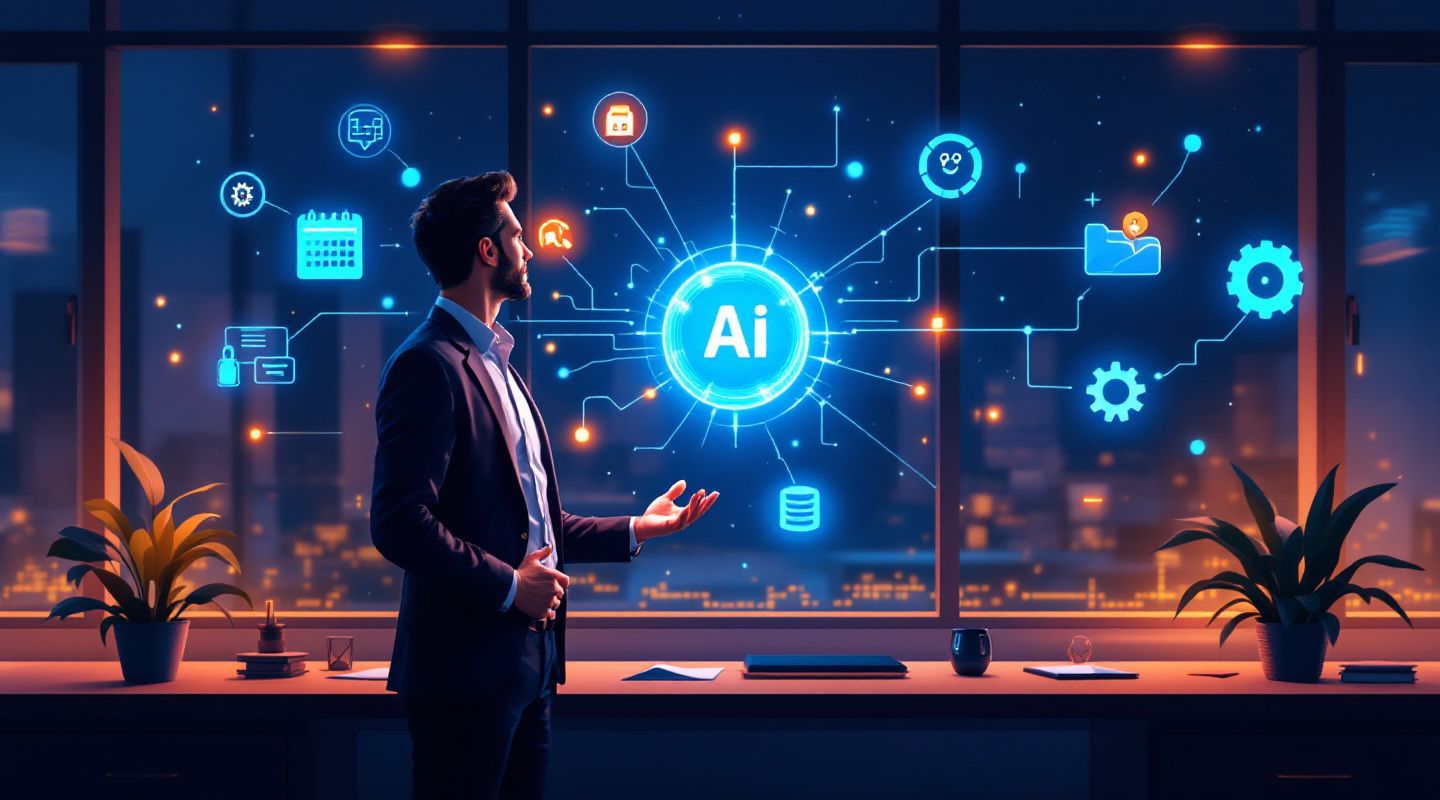
What Is an AI Agent? A Simple Guide for Business Owners.
If you're a business owner trying to figure out whether "AI agent" software is worth paying for, or just another rebrand of tools you already have, you're not confused because you're behind. You're confused because the marketing genuinely muddies the water.
Here's the plain-English version: what an AI agent actually is, how it's different from a chatbot and from traditional automation, and how to tell which one you're actually being sold.
The Short Answer
An AI agent is software that can understand a goal, decide what steps are needed to reach it, take those steps using real tools (a calendar, a CRM, a phone line, a database), and adjust when something doesn't go as expected; all with minimal human babysitting.
That's different from a chatbot, which mostly just talks, it answers questions in a conversation window based on a script or a language model, but it doesn't reach into your systems and do things.
And it's different from traditional automation (think Zapier, RPA, if-this-then-that workflows), which executes a fixed sequence of steps perfectly every time, as long as nothing deviates from what it was programmed to expect.
The difference isn't how smart the tool sounds. It's how much judgment it can exercise before it needs a human to step in.
Chatbots: Conversation, Not Action
A chatbot's job is to respond in a chat interface. Ask it a question, it gives you an answer, pulled from a script, a knowledge base, or a language model. Some are genuinely good at holding a natural conversation.
What a chatbot typically can't do is take multi-step action outside that conversation. It can tell a customer your return policy; it usually can't actually process the return, check inventory, and update the order in your system in the same breath. It's a front door with a very good greeter, but the greeter doesn't have keys to the rest of the building.
Traditional Automation: Perfect Consistency, Zero Judgment
Tools like Zapier, Make, or classic RPA scripts are enormously useful, but they work on rigid logic: when X happens, do Y. New form submission → add row to spreadsheet → send email. It's fast, reliable, and cheap to build.
The catch: it only works when the input looks exactly like what it was built to expect. A slightly different form field, an edge-case customer request, a call that doesn't fit the decision tree, and the automation either breaks or routes the problem straight to a human anyway. It doesn't reason about the situation. It just follows the rule.
AI Agents: Reasoning, Tool Use, and Follow-Through
An AI agent sits above both of these. It can:
- Understand an open-ended goal ("qualify this lead," "resolve this customer's billing issue") rather than needing a rigid script for every scenario
- Use real tools A CRM, a calendar, a phone/SMS line, a database, to actually take action, not just describe what should happen
- Handle multiple steps in sequence, adjusting the plan as new information comes in
- Recognize when it's out of its depth and hand off to a human instead of guessing
That last point matters more than people expect. A well-built AI agent isn't trying to replace judgment, it's trying to expand how much routine work can happen before a judgment call is even needed.
A Concrete Example
Say a customer calls after hours asking to reschedule an appointment and also asks a billing question.
- A chatbot might answer the billing FAQ, then tell the customer to call back during business hours for the reschedule.
- Traditional automation might send a scripted "we're closed" text and log a ticket for someone to handle in the morning.
- An AI agent like Anablock's Echo platform can actually check the calendar, rebook the appointment, pull up the billing answer from the account record, confirm both back to the customer, and only escalate to a human if something in the request doesn't fit any of that (a dispute, a refund request outside policy, anything that needs judgment).
That's the practical difference: one just talks, one just follows rules, and one actually gets the job done end-to-end.
How to Tell Which One You're Being Sold
When you're evaluating any tool marketed as "AI-powered," ask three questions:
- Can it take action in my actual systems, or does it only produce text in a chat window?
- Can it handle more than one step without a human manually connecting the dots between them?
- What happens when the situation doesn't match the expected pattern does it break, guess, or correctly recognize it needs a human?
If the answers are "no," "no," and "it breaks," you're looking at a chatbot or a basic automation wearing an AI label. That's not necessarily bad, those tools have their place, but it's not what "AI agent" is supposed to mean, and it won't save you the time you're expecting.
Where This Fits at Anablock
This is exactly the bar Anablock's AI agents are built to clear. Echo handles voice and SMS end-to-end, booking, rescheduling, FAQ resolution, and escalation, as a real agent, not a scripted phone tree.
Ana, the AI assistant built into Anablock CRM, doesn't just answer questions about your pipeline, she finds leads, enriches contacts, drafts and sends outreach, and reports on what's happening, chaining those actions together inside a single conversation.
If you've been evaluating "AI" tools and walking away underwhelmed, there's a good chance what you were shown was automation with better branding, not an agent.
Want to see the difference firsthand?
Book a call and we'll show you what an actual AI agent does in your business.