- Published on
What's Next for AI Agents in Business? From Assistants to Autonomous Workflows
- Authors

- Name
- Vuk Dukic
Founder, Senior Software Engineer
Most Businesses Are Using AI Like It's 2022. Here's What They're Missing.
You've deployed a chatbot. Maybe you've connected ChatGPT to your team's workflow. Your reps use AI to draft emails faster, and your support team has a bot that answers FAQs. You feel like you're ahead of the curve.
You're not. Not yet.
The businesses that will dominate the next five years aren't the ones that added AI to their existing workflows. They're the ones that rebuilt their operations around AI as the default execution layer. There's a massive difference between those two approaches, and right now, most companies are stuck at the starting line without realizing it.
Here's a clear-eyed breakdown of where AI in business is actually headed, and where you need to be.
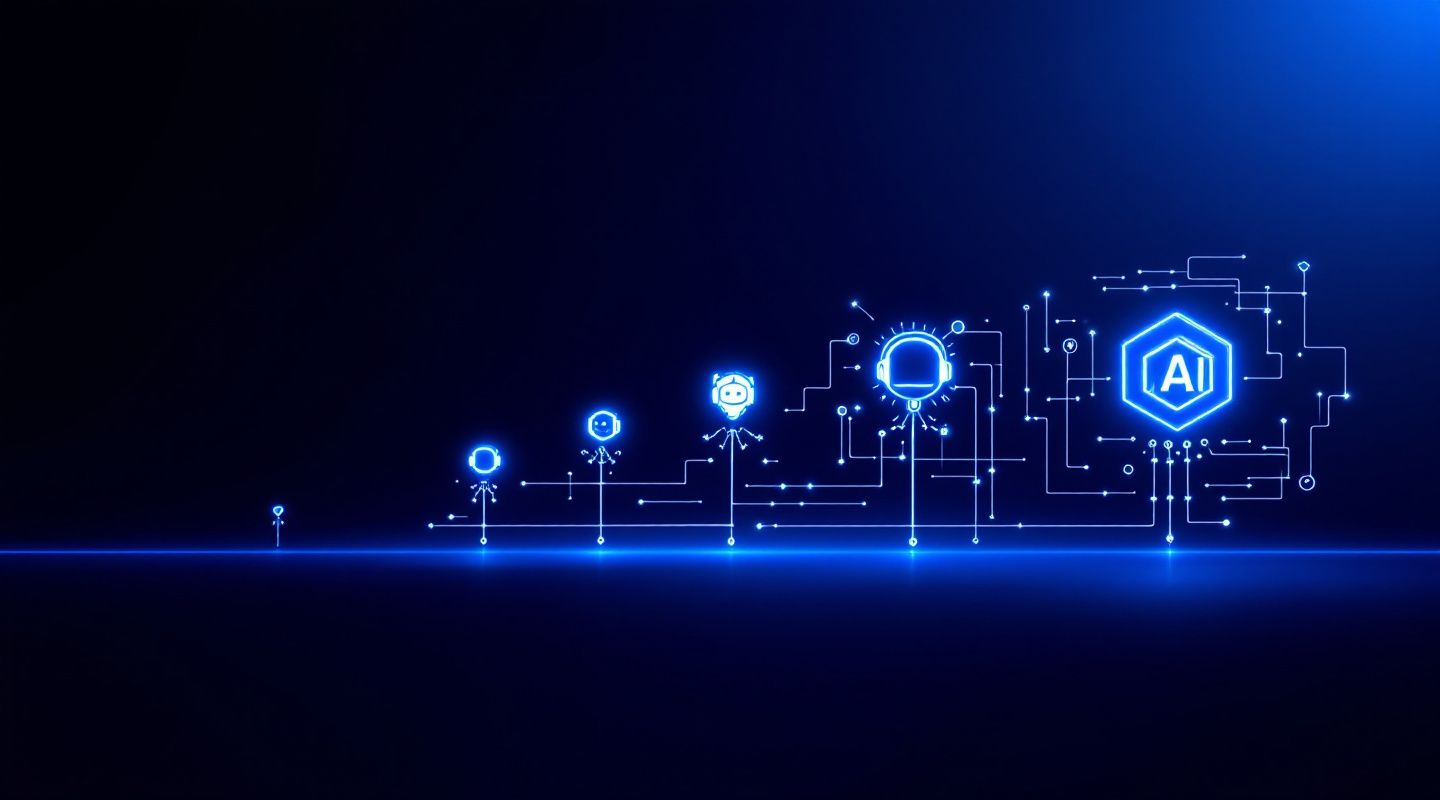
The Five Stages of AI Evolution in Business
Stage 1: Chatbot, Scripted Responses, Zero Intelligence
The chatbot era gave businesses a way to deflect simple queries at scale. Rule-based, menu-driven, FAQ-powered. Type a question, get a canned answer. No context. No memory. No judgment.
What it unlocks: Basic self-service, reduced tier-1 support volume.
What's still missing: Everything. The bot doesn't know who you are, what you've bought, or what you actually need. It breaks the moment a question falls outside its script.
What the business looks like: A company with a chat widget on their website that frustrates 60% of visitors and resolves maybe 20% of issues without human escalation.
Most businesses launched a chatbot between 2018 and 2022 and called it an AI strategy. It wasn't.
Stage 2: Copilot, AI Assists, Humans Still Do the Work
The copilot stage is where most businesses sit today. AI embedded into existing tools, your CRM, your inbox, your docs, that suggests, drafts, and summarizes. GitHub Copilot for code. AI email assistants. ChatGPT for content. Your rep still makes every decision and takes every action. The AI just makes them slightly faster.
What it unlocks: Individual productivity gains of 20-40%. Faster drafts, better summaries, quicker research.
What's still missing: Autonomy. The AI waits to be prompted. It doesn't act. It doesn't remember context across sessions. Every workflow still requires a human in the loop at every step.
What the business looks like: A team that's individually more productive but operationally identical to before. You've sped up the humans; you haven't changed the system.
This is a real gain, but it's table stakes, not competitive advantage.
Stage 3: AI Agent, Autonomous Action Across Systems
This is where things get serious. An AI agent doesn't just suggest. It acts. It can read and write to your CRM, qualify inbound leads, send outreach sequences, enrich contact records, book meetings, and complete multi-step tasks end to end, without someone clicking a button each time.
What it unlocks: True operational leverage. One agent can handle the workload of multiple SDRs or support reps, working 24/7, with consistent quality and zero fatigue.
What's still missing: Specialization and scale. A single agent handling everything creates bottlenecks. The agent is powerful, but it's still working alone.
What the business looks like: A lean team running at the output of a much larger one. Sales pipeline fills with qualified leads without manual prospecting. Follow-ups never fall through the cracks. Customer questions get answered at 2am on a Sunday.
This is where Anablock operates today. Ana is an AI agent embedded directly in the CRM with live read/write access to contacts, pipeline, and deals. She independently drafts and sends outreach, runs lead enrichment, schedules follow-up sequences, and pulls analytics, not when someone asks her to, but as an ongoing autonomous process. Echo, Anablock's AI voice and text agent, handles inbound customer conversations and appointment booking around the clock, qualifying interest and routing intent without human involvement.
Stage 4: Multi-Agent Workflow, A Virtual AI Team
At stage 4, the competitive advantage compounds dramatically. Instead of one agent doing everything, you have specialized agents coordinating like a team, each owning a function, passing context between them, and running entire business processes end to end.
Think: one agent handles outbound prospecting. Another manages inbound qualification. A third runs scheduling and calendar coordination. A fourth monitors customer health and flags churn risk. They share a memory layer, hand off cleanly, and operate as a synchronized system.
What it unlocks: Entire departments running autonomously. Not just faster humans. Replaced workflows. Sales, support, and customer success running at scale with minimal headcount.
What's still missing: Strategic judgment and relationship depth. Multi-agent systems excel at execution. They still need humans to set direction, manage edge cases, and build the relationships that matter.
What the business looks like: A 10-person company operating with the output of a 50-person team. Every lead gets touched. Every customer gets followed up with. Every opportunity gets worked.
Ana and Echo already operate as coordinated agents in this model, with Ana managing the pipeline intelligence layer while Echo owns the conversational front end. This is a working preview of what multi-agent infrastructure looks like in a real business context.
Stage 5: AI-Native Business, AI Is the Operating System
The end state. In an AI-native business, AI agents are the default execution layer across the entire company: sales, support, ops, product, customer success. Humans don't do the execution anymore. They set strategy, make judgment calls, manage the agents, and handle the relationships and decisions that genuinely require human intelligence.
What it unlocks: Unlimited operational scale without proportional headcount growth. The ability to compete with enterprises while operating lean.
What's still missing at this stage: We're still early. Most tooling, infrastructure, and trust frameworks for fully AI-native businesses are being built right now. But the trajectory is clear.
What the business looks like: A company where the organizational chart includes AI agents as first-class operators. Where founders and leaders spend their time on vision, partnerships, product direction, and customer relationships, not execution.
Where Are You Right Now?
Be honest. If you have a chatbot on your site and your team uses AI to write emails faster, you're at stage 1 to 2. That's not a criticism. Most businesses are. But the gap between stage 2 and stage 3 is where the real competitive distance is being created, right now, by companies that are moving fast.
The question isn't whether AI agents will transform your industry. They already are. The question is whether you're the one deploying them, or competing against someone who did.
Move Up the Curve. Now.
Anablock is already operating at stages 3 and 4, and we build the same infrastructure for the businesses we work with. Whether you're still running on chatbots, stuck in copilot mode, or ready to deploy your first autonomous agents, we can show you exactly what the next stage looks like for your business, and build it with you.
Ready to stop assisting and start automating? Book a call with our team and get a clear picture of where you are today and what moving to stage 3 or 4 looks like in practice.
Book Your Strategy Call: https://crm.anablock.com/book/vuk/meet-with-vuk