- Published on
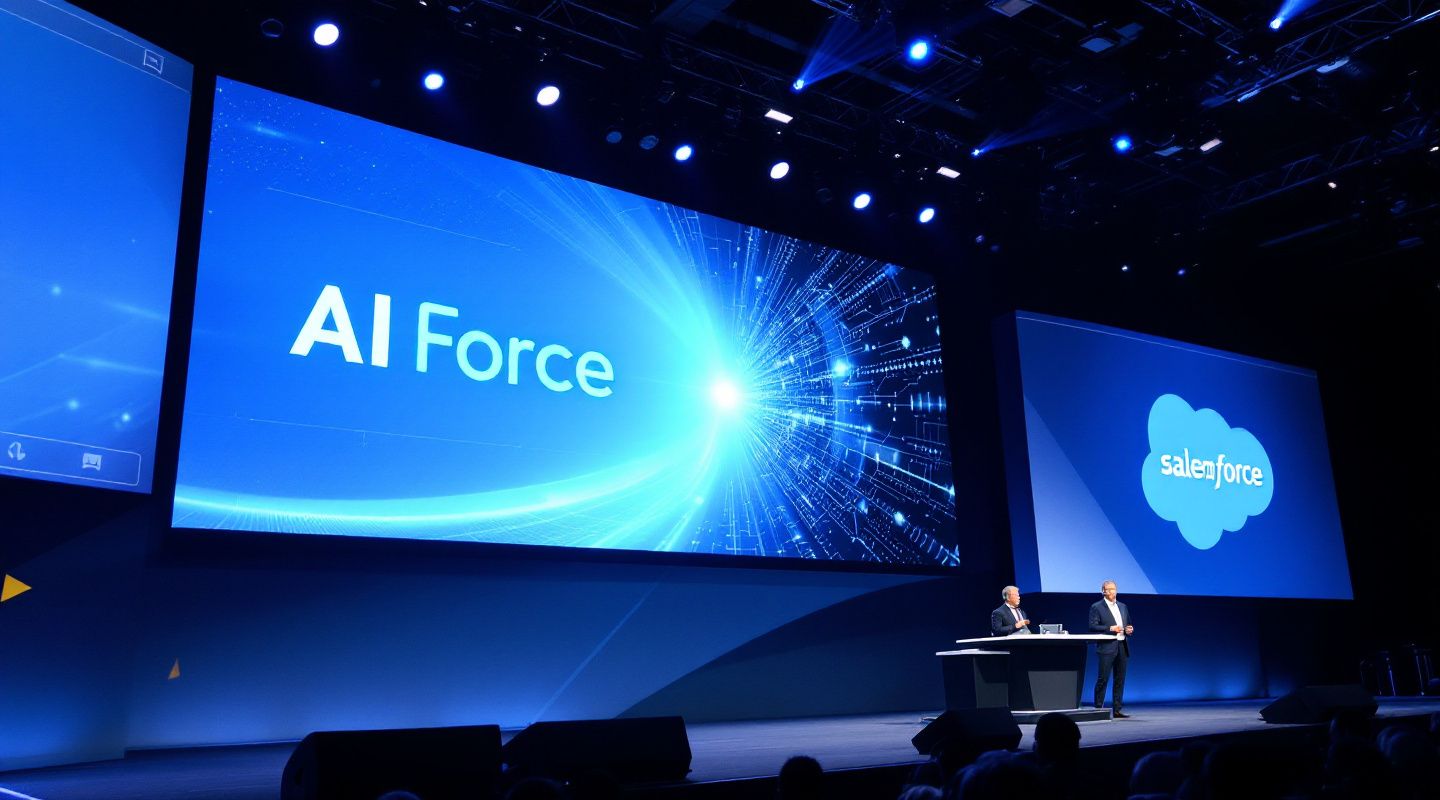
Dreamforce 2026 Day 1: The AIforce Announcement Everyone's Talking About
- Authors

- Name
- Vuk Dukic
Founder, AI/ML Engineer
Dreamforce 2026 Day 1: The AIforce Announcement Everyone's Talking About
If you've ever watched a confident AI assistant give you a completely wrong answer — and then watched a colleague almost act on it — you already understand exactly why Salesforce's biggest Dreamforce 2026 announcement matters.
Benioff opened the Day 1 keynote with a story that hit close to home for anyone who's been burned by disconnected AI tools. A friend built an app on top of Claude. It looked polished, it spoke authoritatively, and it produced numbers that were completely, confidently wrong — because it wasn't connected to any real business data. It was, in Benioff's words, a sophisticated guessing machine.
That story isn't an edge case. It's the current state of enterprise AI for most companies. And AIforce is Salesforce's answer to it.
What AIforce Actually Is — And Why It's Different
AIforce isn't a new product you buy separately. It's a foundational layer Salesforce is weaving across its entire platform. The core idea: ground every AI interaction in your real CRM data, your actual business rules, and your existing permissions — so AI stops guessing and starts knowing.
The problem with most AI deployments today isn't that the models are bad. It's that the models are floating. They don't have access to your pipeline data, your custom objects, your approval workflows, or the nuanced rules your RevOps team spent months building. So they hallucinate. They hedge. They answer confidently and incorrectly.
AIforce closes that gap. Here's how it shows up across three major surfaces:
Claudeforce: Salesforce Data Inside Claude, Without the Context Switch
For sales reps and ops leaders who live inside Claude for research, drafting, and analysis, Claudeforce brings your Salesforce data directly into that environment. You no longer have to open a new tab, pull a report, screenshot it, paste it, and hope the AI understands the context.
You can ask Claude about your actual pipeline — specific deals, real forecast numbers, live account data — and get answers grounded in truth rather than general knowledge. This is the difference between a useful AI assistant and an unreliable one.
Slackforce: Live Intelligence Where Your Team Already Works
Slackforce brings the same grounding into Slack. But the detail that stood out most in the keynote wasn't just the data integration — it was that Slackforce can generate live dashboards directly inside a Slack channel. Not a text summary of a dashboard. Not a link. An actual dynamic visual that updates in real time.
For RevOps leaders who spend their days toggling between Slack conversations and reporting tools, this is a meaningful workflow change. Your team can discuss pipeline in the same message thread where the live data is sitting.
Agentforce Coworker: AI That Feels Like a Teammate, Not a Chatbot
Inside standard Salesforce, the Agentforce Coworker experience is designed to feel less like querying a system and more like working alongside a knowledgeable colleague. One that knows your deals, your customers, your rules, and your history — because it's pulling from all of them.
The positioning here is intentional. Chatbots create distance. Coworkers create trust. Salesforce is betting that the mental model matters as much as the functionality.
The SDK: Because Not Every Business Problem Looks the Same
One of the most practically important announcements didn't get as loud a reaction, but it should have. Salesforce is releasing an SDK that lets companies build their own custom AI agents — rather than relying solely on default agents like Piper or Hunter.
This matters because off-the-shelf agents are built around common use cases. Your business isn't common. Your sales motion, your data model, your compliance requirements, your customer segments — they're specific. The SDK acknowledges that reality and gives technical teams the tools to build agents that actually match how their business works.
For IT and ops decision-makers evaluating AI platforms, this is the difference between buying a tool and building a capability.
Governance and Security: The Infrastructure Behind the Intelligence
More agents running means more complexity — and more risk. Salesforce addressed this directly with two new additions that RevOps and IT leaders should pay close attention to.
Agent Fabric is the mission control layer for your entire agent ecosystem. It shows you:
- Every agent currently running — including non-Salesforce agents
- What data each agent is touching
- What each agent is costing you
- Flags for anything that looks suspicious or out of bounds
This is the operational visibility that most enterprise AI deployments currently lack. When you have ten agents running across five platforms, understanding what they're doing and what they're accessing is non-negotiable.
Salesforce Guardian is the security layer working beneath Agent Fabric. It catches rogue agents, enforces data boundaries, and ensures sensitive customer and business data stays locked down — even as the number of agents scales up.
Both tools reflect a maturity in how Salesforce is thinking about AI: not just what it can do, but what happens when it does something it shouldn't.
Zero Data Retention: A Commitment That's Backed Up
Salesforce reaffirmed its zero data retention policy — your customer data does not train any model — and notably, this commitment was backed by Anthropic, AWS, Google, Nvidia, and OpenAI. That's a meaningful alignment across the AI ecosystem, not just a Salesforce marketing promise.
For enterprise buyers where data privacy and compliance are table-stakes requirements, this matters. It means you can deploy AI agents with grounded access to sensitive business data without handing that data over to model training pipelines.
The Takeaway That Cuts Through the Keynote Noise
Here's the honest summary of Dreamforce 2026 Day 1: AI alone cannot run a business.
It needs real data to work from. It needs a way to manage many agents running simultaneously. And it needs real security to make sure it doesn't go off the rails. Without those three things, you don't have an AI-powered business. You have a confident-sounding guessing machine that occasionally gets things right.
AIforce is Salesforce's architecture for solving all three. Grounded data through Claudeforce, Slackforce, and Agentforce Coworker. Operational visibility through Agent Fabric. Security through Guardian. And the flexibility to go beyond defaults through the SDK.
This is the direction enterprise AI is heading — and the companies that build on grounded, governed, secure AI infrastructure now will have a significant advantage over those still running disconnected tools.
How Anablock Helps You Get There
At Anablock, we've been doing the work of grounding AI agents in real business data — actual CRM records, live pipeline data, custom workflows, and operational rules — long before it became the headline at Dreamforce.
We help sales and ops teams move from AI experiments to AI infrastructure: agents that know your business, work inside your existing tools, and operate with the governance your IT team requires.
If Dreamforce 2026 has you thinking seriously about where your AI strategy needs to go next, let's talk about what that looks like in practice for your specific environment.