- Published on
Dreamforce 2026 Day 1: The Keynote Recap for Anyone Who Missed It
- Authors

- Name
- Anablock
AI Insights & Innovations
Dreamforce 2026 Day 1: The Keynote Recap for Anyone Who Missed It
If you've ever watched a sleek AI demo produce a perfectly formatted answer that turned out to be completely wrong, you already understand the problem Salesforce spent most of Day 1 trying to solve.
Marc Benioff opened the keynote not with a product announcement, but with a story. A friend had built an impressive-looking app using Claude. The dashboards were beautiful. The numbers were crisp. The only problem: the numbers were made up. The AI wasn't pulling from real business data. It was pattern-matching its way to confident-sounding fiction. The app looked like a finished product and functioned like a hallucination.
That story set the tone for everything that followed.
The Big Announcement: AIforce
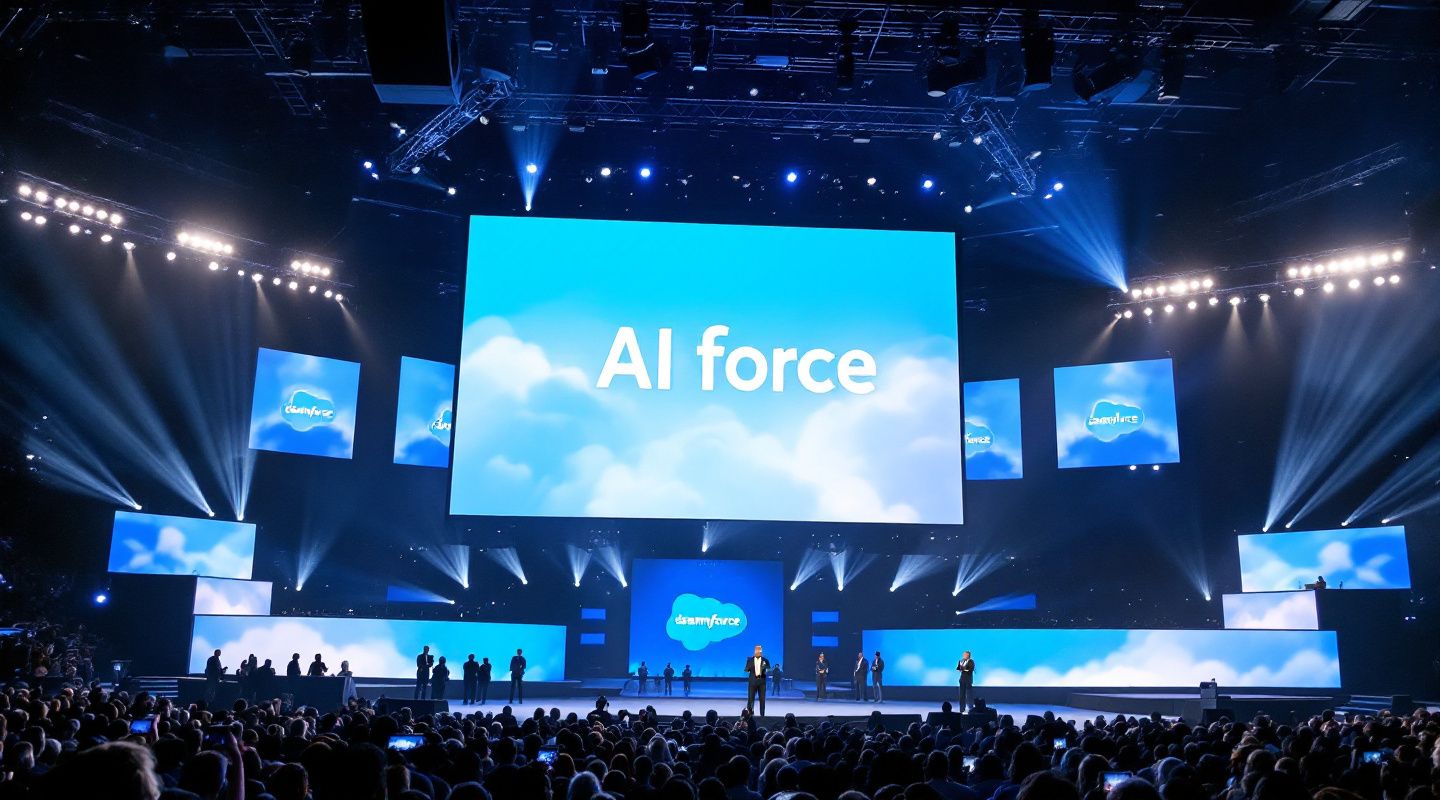
The headline announcement from Dreamforce 2026 Day 1 is AIforce, a new Salesforce layer that does one thing the current generation of AI tools largely doesn't: it connects AI models directly to real business data, real permissions, and real workflows.
Instead of AI sitting alongside your CRM as a disconnected assistant that guesses at context, AIforce wires it in. The AI knows what your data actually says. It respects who has access to what. It operates inside the workflows your business already runs on.
This is a meaningful architectural shift, not a feature update. And it shows up in three distinct places.
Claudeforce: Your CRM Data Inside Claude, No Tab-Switching Required
The first surface is Claudeforce, which brings live Salesforce data directly into Claude. Sales reps can ask Claude a question about a deal, an account, or a forecast and get an answer grounded in actual CRM records — without leaving Claude, without switching context, without copying and pasting pipeline data into a chat window.
This matters more than it sounds. Today, most AI-assisted selling involves a rep juggling multiple tools: the CRM in one tab, an AI assistant in another, a spreadsheet somewhere else. Claudeforce collapses that into a single grounded conversation. The AI knows what's in the record because it's actually reading the record.
Slackforce: Live Business Intelligence Where Your Team Already Works
The second surface is Slackforce, bringing the same grounded data intelligence into Slack — including the ability to post live dashboards directly into channels.
For RevOps and sales leadership, this is significant. Instead of asking someone to pull a report, a team can surface real-time pipeline data, quota attainment, or deal health directly in the channel where the conversation is already happening. The data moves to where the people are, and it stays live.
Agentforce Coworker: AI That Feels Like a Colleague, Not a Chatbot
The third surface is Agentforce Coworker, the same grounded AI capability built into Salesforce itself. Salesforce was deliberate about the name. The goal is for this to feel like working alongside a knowledgeable colleague — one who knows your accounts, your data, and your business rules — rather than querying a chatbot that might or might not know what it's talking about.
Building Custom Agents With the New SDK
Salesforce also acknowledged something that enterprise buyers have been saying quietly for a while: default AI agents don't fit every business problem.
To address that, Salesforce launched an SDK for building fully custom agents. Companies no longer have to rely solely on pre-built agents like Piper or Hunter. If your business processes don't map cleanly onto a default agent's assumptions, you can build one that does. This is a significant unlock for enterprise organizations with complex or industry-specific workflows that off-the-shelf agents simply can't handle.
Managing the Agent Sprawl Problem: Agent Fabric and Salesforce Guardian
Here's a challenge that doesn't get enough attention: as AI agents multiply across a business, managing them becomes its own operational problem. Who's running what? What data is each agent touching? What is it costing? And if something goes wrong, how do you catch it?
Salesforce introduced two answers to this.
Agent Fabric is a mission-control layer that gives you visibility across every agent running in your business — including agents that weren't built by Salesforce. It shows you what each agent is doing, what data it's accessing, what it's costing, and flags anything that looks suspicious. For a RevOps leader or an IT team managing an expanding AI footprint, this is the kind of observability that turns agent deployment from a risk into a manageable operation.
Salesforce Guardian sits underneath as the security layer, specifically designed to catch rogue agents and protect sensitive data. As the number of agents in enterprise environments grows, the attack surface and compliance exposure grow with them. Guardian is Salesforce's answer to the question of what happens when an agent does something it shouldn't.
On Trust and Data: The Zero Retention Commitment
Salesforce also reinforced its zero data retention commitment — your customer data is not used to train AI models. This was backed visibly by Anthropic, AWS, Google, Nvidia, and OpenAI. For enterprise buyers who have been cautious about AI adoption for exactly this reason, this partnership signal matters. It's not just a policy statement from one vendor; it's a commitment with infrastructure and partner accountability behind it.
The Real Takeaway From Day 1
Strip away the product names and the keynote production, and the argument Salesforce made on Day 1 is straightforward:
- AI alone can't run a business. A model without grounded data is a confident-sounding guessing machine.
- Agents without visibility are a liability. As agent deployments scale, you need observability and control, not just capability.
- Security can't be bolted on after the fact. It has to be part of the architecture from the start.
These aren't novel insights — but Salesforce is now building product infrastructure around them at scale, which changes the conversation for enterprise buyers who have been waiting for AI to move from impressive demos to reliable business operations.
What This Means If You're Evaluating AI + CRM Today
The themes from Day 1 at Dreamforce 2026 are exactly the principles that guide how Anablock approaches AI agent deployment for our clients.
We build AI agents wired directly into your CRM and core business systems. Grounded in real data. Operating within your actual permissions and business rules. With governance, visibility, and security built into the architecture from day one — not added as an afterthought when something breaks.
The Benioff story about beautiful dashboards with wrong numbers isn't a hypothetical. We've seen the same pattern. AI that looks capable but isn't grounded produces confident mistakes at scale. The fix isn't a smarter model — it's a smarter architecture.
If Dreamforce Day 1 made you think harder about what it would take to actually deploy AI that your business can rely on, we'd like to show you what that looks like in practice.
Schedule a meeting with the Anablock team to see what an AI-first CRM grounded in real data, built with governance from the ground up, looks like for your business.