- Published on
From Seed to Scale: Where AI Agents Can Give a Growing Startup an Operational Advantage
- Authors

- Name
- Vuk Dukic
Founder, Senior Software Engineer
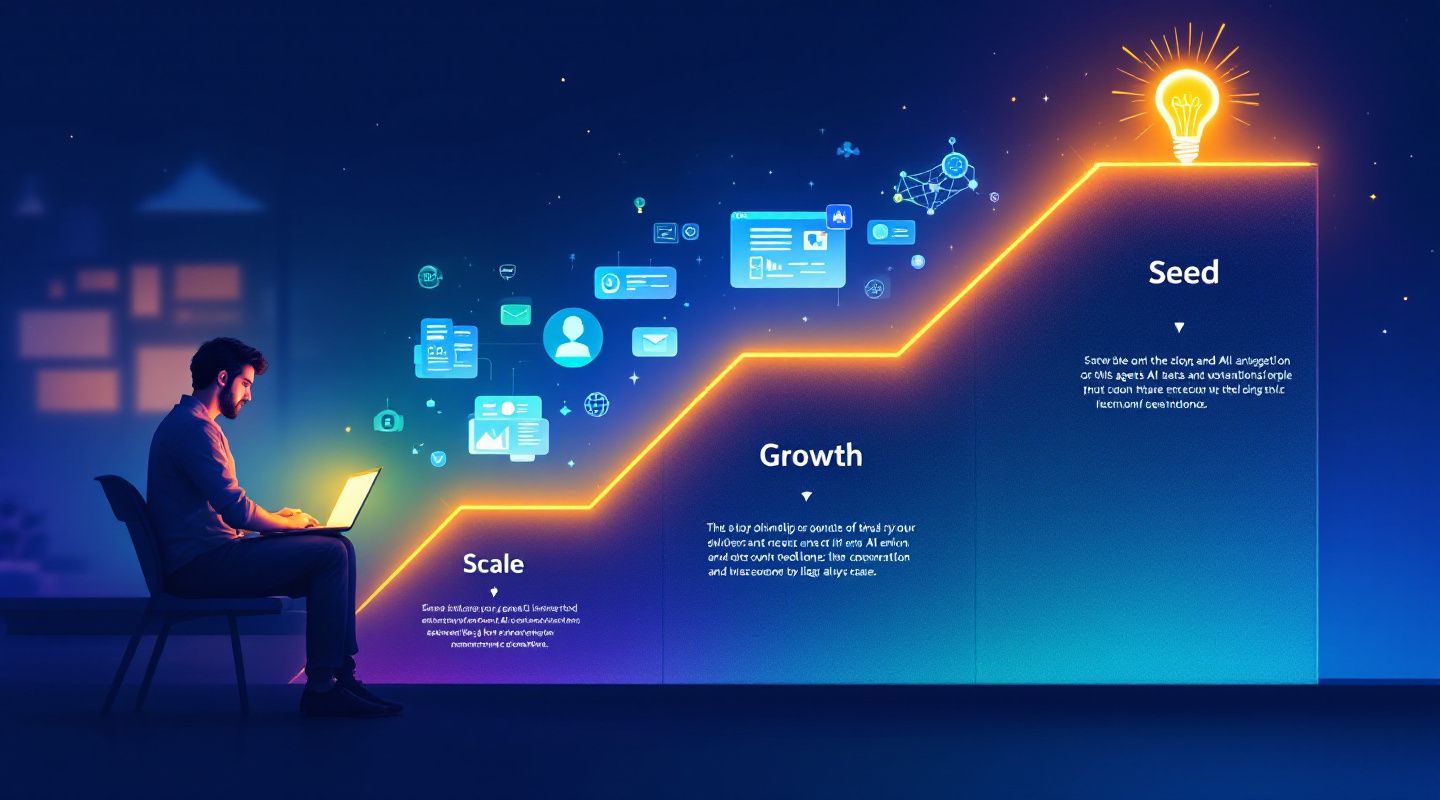
From Seed to Scale: Where AI Agents Can Give a Growing Startup an Operational Advantage
It is 11 PM. You have three people on your team, a product that customers actually want, and a to-do list that keeps growing faster than you can shrink it. You are answering support emails with one tab open, chasing leads in a spreadsheet with another, and somewhere in the back of your mind you are composing the investor update you promised to send three days ago. You are not failing. You are just being asked to do the work of ten people with three. This is the seed-stage reality, and nearly every founder lives it.
The good news is that the gap between what you can hire and what you need to execute is exactly where AI agents thrive. And the even better news is that the same AI-first infrastructure that helps you survive seed stage can scale with you through growth and into an operation with hundreds of people across multiple teams.
Here is a practical look at where AI agents create the most operational leverage at each stage of the journey.
Seed Stage (1 to 10 People): Speed and Leverage Without Headcount
At seed stage, the biggest risk is not competition. It is dropped balls. An inbound lead that goes cold because nobody followed up. A support question that sat for two days. A promising prospect who never got the meeting link.
AI agents close those gaps without adding payroll.
High-impact use cases at seed stage:
- AI lead capture and instant follow-up. Every inbound inquiry gets an immediate, intelligent response. No lead goes cold because it arrived on a Friday afternoon.
- Automated outreach and follow-up sequences. Write the sequence once, deploy it to every qualified prospect, and let the agent handle the cadence.
- Meeting scheduling. No more back-and-forth emails. The agent qualifies the lead and books the call.
- Basic support triage. Common questions get answered automatically. Complex issues get routed to a human with context already attached.
- A CRM that updates itself. Calls, emails, and meetings log automatically. You stop entering data and start using it.
- Quick content drafting. Proposals, follow-up summaries, and outreach copy drafted in seconds, not hours.
The advantage here is pure leverage. You operate at the capacity of a much larger team without the overhead. You also build habits and workflows that will matter later.
Growth Stage (10 to 100 People): Consistency and Capacity as Volume Rises
Something shifts when you cross ten or fifteen people. The problem is no longer just getting things done. It is getting things done the same way, every time, at increasing volume. One sales rep follows up four times. Another follows up once. One onboarding email goes out in an hour. Another takes two days. The inconsistency costs you deals and customers you never even realize you are losing.
This is where AI agents move from survival tools to growth infrastructure.
High-impact use cases at growth stage:
- Lead scoring and qualification. Agents evaluate inbound leads so your reps spend time on the best opportunities instead of working every contact equally.
- Multi-step nurture at scale. Sequences that would take a human days to execute run automatically across hundreds of contacts.
- Pipeline hygiene and stale deal alerts. The agent flags deals that have gone quiet and prompts the rep to act before the opportunity slips.
- AI voice agents for after-hours and overflow calls. A voice agent like Echo can handle inbound calls when your team is unavailable, qualify the caller, capture information, and route or schedule appropriately.
- Support deflection. A growing support volume gets handled without a proportional increase in headcount.
- Customer onboarding automation. New customers receive consistent, well-timed communications that set them up for success.
- Automated reporting. Leadership and investor updates pull from live data instead of eating three hours of someone's weekend.
The advantage is consistency. Every prospect gets the same quality of follow-up. Every new customer gets the same onboarding experience. Your process becomes a real asset instead of something that depends on which team member is having a good week.
Scale Stage (100+ People): Operating Leverage Across Teams and Regions
At scale, the pain is coordination and complexity. You have multiple teams, possibly multiple regions, and processes that were designed for fifty people but are now serving five hundred. Data quality degrades. Handoffs break down. The cost of running the operation grows alongside revenue, sometimes faster.
AI agents at this stage are about building operating leverage, meaning revenue and output grow faster than headcount and cost.
High-impact use cases at scale:
- Portfolio-wide and multi-team automation. The same playbooks run across every team and region with local customization where needed.
- Standardized workflows codified as reusable skills. Best practices are not in someone's head. They are built into the system and deployed consistently.
- Semantic search and analytics across large datasets. Reps and leaders can query contact history, pipeline data, and customer records in plain language.
- Enrichment and prospecting automation. The agent continuously updates contact and company data so your team is always working with accurate information.
- Cross-team handoffs. Marketing to sales to customer success transitions happen with full context automatically passed along.
- Governance and human review. Approval workflows and human-in-the-loop checkpoints ensure that high-stakes decisions still get the judgment they deserve.
How to Choose Your First Agent
If you are not sure where to start, pick the workflow that is the most repetitive, the highest volume, and the lowest risk if something goes slightly wrong. That usually means lead follow-up or support triage at seed stage, pipeline hygiene or scheduling at growth stage, and reporting or enrichment at scale stage.
Start narrow. Get one agent running well, measure the time saved and the outcomes improved, and then expand. The goal is not to automate everything at once. It is to build confidence and momentum.
And keep humans in the loop. AI agents are excellent at high-volume, rule-based, pattern-matching work. Judgment calls, sensitive customer conversations, and anything with significant consequences should still have a human review step built in. The best implementations are the ones where agents handle the volume and humans handle the nuance.
One System That Grows With You
One of the practical challenges of scaling a startup is that tools you deploy at seed stage break down at growth stage, and you end up replacing point solutions every eighteen months. Each replacement costs time, money, and institutional knowledge.
An AI-first CRM with a built-in assistant like Ana and a voice agent like Echo is designed to carry you from your first ten customers to your first ten thousand. The same contact records, the same pipeline logic, the same workflows, just with more agents, more skills, and more automation layered in as your needs grow. You are not buying a seed-stage tool. You are building on infrastructure that scales.
A Simple Comparison: What to Automate at Each Stage
- Seed: Lead capture, follow-up, scheduling, support triage, CRM data entry, content drafting
- Growth: Lead scoring, multi-step nurture, pipeline hygiene, voice overflow, onboarding, reporting
- Scale: Multi-team playbooks, cross-team handoffs, semantic analytics, enrichment, governance
Ready to Map Your Stage and Your First Agent?
Whether you are answering support emails at 11 PM or managing a revenue team across three regions, there is a specific workflow in your operation right now that an AI agent could handle better, faster, and more consistently than the current process.
The best next step is a focused conversation about where you are, where you are going, and which agent to deploy first. Book a call with Vuk and let us map your stage, identify your highest-leverage starting point, and show you what an AI-first operation actually looks like in practice.